Telematics as a System
A dash cam records what happened. A telematics system explains why it happened so you can decide what to do next. Learn how AI analysis and the exponential power of integrated data can help transportation providers move from reacting to problems to preventing them.
- Published
- Reading
- 6 min
- Topic
- Operations
Placing a simple dash camera in your personal vehicle gives you results you can understand immediately. The camera is a witness that records exactly what happens on the road in front of you, and you can return to any moment of that footage and see what happened. Such footage can also be helpful in fleet vehicles as a visual record that shows exactly what happened during a given event. But a successful transportation provider needs to know much more than that. They need insight, accountability, and control that gives them clarity across their entire operation.
They need telematics.
Telematics pulls together a variety of technologies that help a vehicle collect information about itself, such as where it is and how fast it’s going, how carefully it’s being driven, and its overall mechanical health. That information is then sent across a common mobile wireless connection to someone who can use it.
What Does a Telematics System Look Like?
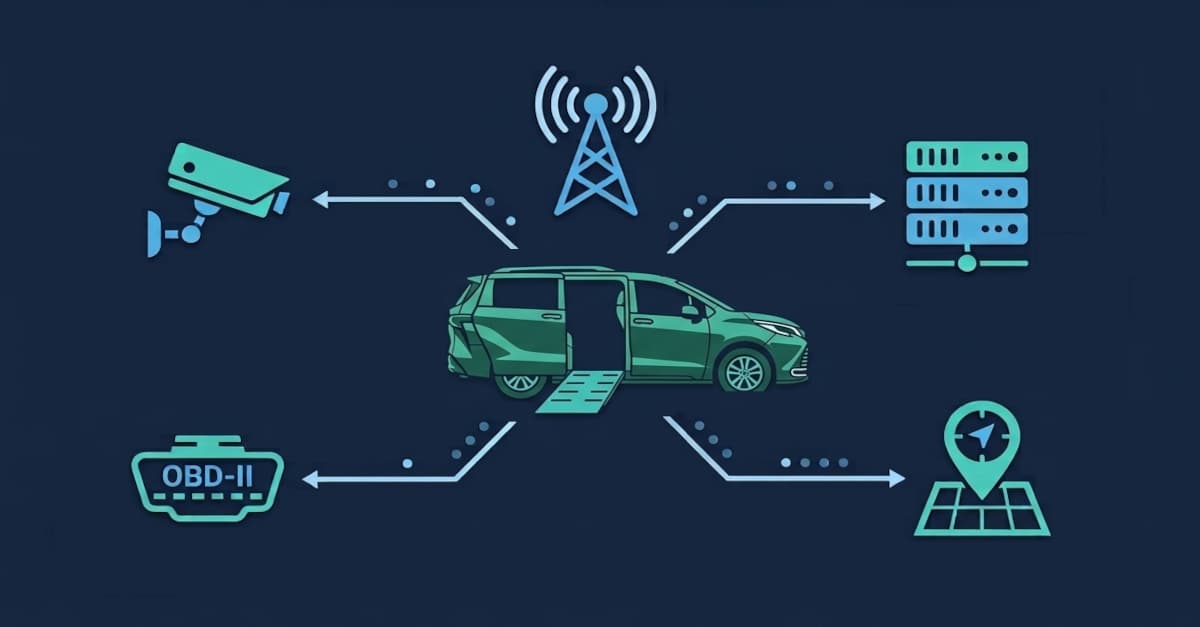
The hardware needed to capture and transmit telematics information comes in different form factors. A simple system might feature a driver’s mobile app that relies on the phone’s onboard GPS and cellular connectivity to transmit location and other details to a central server for the dispatcher and company officials to analyze. A more sophisticated system might include one or more camera, sensing, and processing devices linked together to capture and transmit video, location, motion and much more. The type of technologies that are commonly used in telematics systems include the following:
- GPS receivers that track a vehicle’s location, speed, and direction.
- Cameras (road-facing and/or interior) transmit video that can be viewed live and also archived for a defined period for auditing purposes.
- Onboard AI machine learning models can combine video footage and other inputs to detect driver distraction or drowsiness, lane wandering, and more.
- Accelerometers and other motion sensors can detect hard braking, acceleration, cornering, and even crash events.
- Connections through OBD-II or CAN ports can read data and statistics from the vehicle’s computer such as fuel level, odometer readings, and engine fault codes.
- Aftermarket safety systems such as panic buttons or wheelchair lift and lock sensors.
- A cellular modem that sends this data to a cloud server.
- A software platform connected to the cloud server that offers dashboards, reports, and other analysis tools to help company officials see trends and monitor the health of their fleet.
From Collection to Action
So, how does all this data flow from the vehicle to you, and how do quality systems make sense of this flood of information and give you meaningful insights into your operation?
It starts, of course, with capture. Most of the technologies discussed previously record raw signals on a continuous basis, whether it’s video or a constant influx of GPS, accelerometer, or OBD-II data. At this point, all these inputs are separate streams with little relationship to each other, just numbers. A continuous video stream is worth keeping in its entirety, but not all data should be saved. The in-vehicle hardware filters it and looks for patterns, such as strong braking or even an impact that triggers it to assemble that and related information as an event worthy of immediate attention.
Once filtered and packaged, the data is sent across a 4G/5G cellular network to a cloud server. If service is cut, most telematics hardware will buffer the data and resend it when the connection is reestablished. Processing in the cloud comes next. Data from the vehicle is combined with information the platform already knows such as trip schedules and assigned drivers. A simple GPS ping at 10:15am becomes “Vehicle 23 arrived at the pickup point 15 minutes late.” Additional rules are run, and a sudden braking event becomes an alert that says “Johnathan in vehicle 12 braked suddenly at 65 mph on Interstate 20 with a passenger onboard.” Not all processing is focused on immediate activities, however. Systems like Naveera can intake thousands of pings from different vehicle sensors to generate short- and long-term trend analyses of the performance of each driver and the maintenance needs of each vehicle.
The final step is when that processed information is presented on a software platform so users with different roles and responsibilities can see it and act on it. Dispatchers, for example, see a map with live fleet movements and on-screen alerts. Managers see driver event histories so they can reward good performance or develop coaching plans to correct poor habits. Mechanics see fuel consumption, engine fault codes, and maintenance due dates so they can plan repairs that help you optimize how long each vehicle stays on the road. Even drivers can see feedback about their performance through the driver’s app.
Selecting the Right Telematics System
We’ve seen how telematics systems can incorporate multiple inputs depending on how the in-vehicle hardware is configured. Some systems are simpler than others and may not offer advanced AI analysis features, for example.
First, lean toward a holistic system, such as Naveera. When you capture in-vehicle data and office-based information (trip scheduling, billing, and driver/vehicle details) all in one platform, your ability to gain insights across your entire organization increases because you’re drawing from a much larger pool of co-located data. Systems that only address routing or that only focus on cameras can’t give you the same quality insight into your operation because they don’t talk to each other. If you plan to improve your efficiency to reduce costs, or if you plan to grow your fleet, you need a platform that gives you broad, integrated data and analyses so you can make important decisions with confidence.
Second, plan for where your company will be in 5 years. Think beyond what your company currently needs just to “get by” and plan for the fleet you intend to build. It’s not as expensive as you might assume. Naveera’s per-vehicle pricing model (and no onboarding fee) means you can access the advanced data collection and analysis features discussed above and only pay for the vehicles currently in your fleet. This is a system that grows with you, but only when you decide to scale. We chose this approach because we believe cost should not be a barrier to world-class technology.
Lastly, look for a telematics system from a company with a commitment to robust design. This includes integrating the telematics hardware into a larger and well-thought-out platform, as we discussed above. But it also means a company that carefully designs the hardware itself to fully support the entire system’s capabilities now and in the future. For Naveera, this means carefully choosing the camera modules and onboard AI chips ourselves, and constantly working to improve the accuracy of the large language models that help you spot trends, gain insights, and make better decisions.